
Stroke Recovery BC | Community Programs

Overview | Stroke Recovery Community Programs in BC

I’ve seen all these people that have had to come up from learning to eat and talk and everything else again. Before this group, I think I kind of almost had just given up – whatever will be will be – you know, that kind of thing.
But now I feel like it’s worth pushing myself.

-Stroke Recovery BC program participant

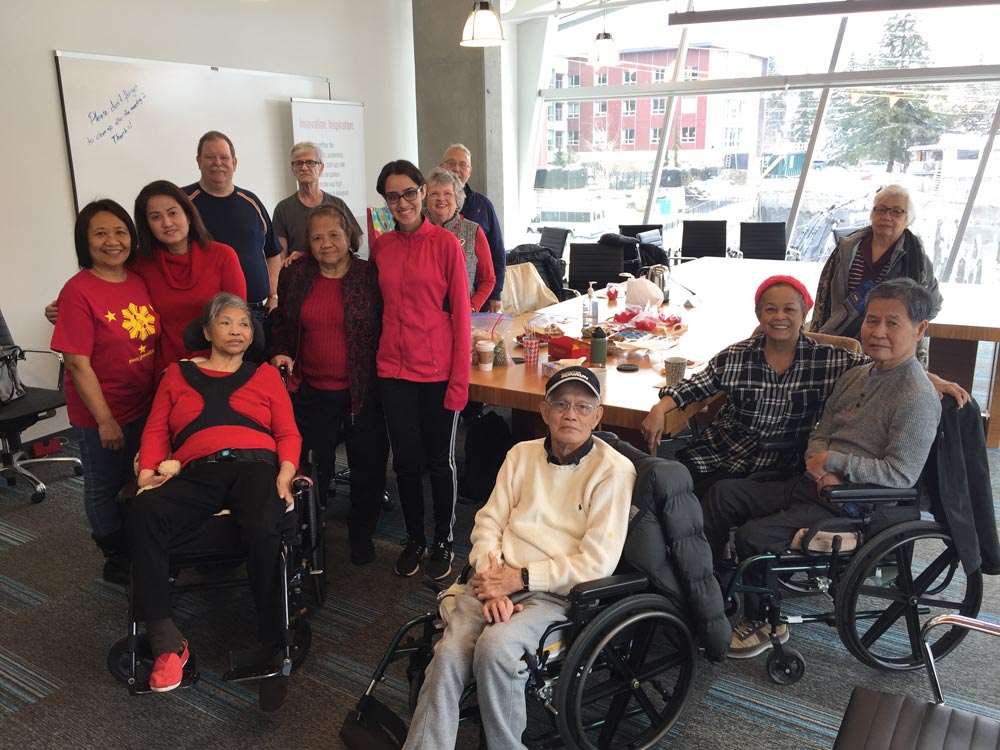
Our Weekly Stroke Recovery programs are delivered across BC.

The programs are designed to help stroke survivors set and achieve individual goals for recovery and getting back to life after stroke.

Activities include:
Education and discussion topics around stroke recovery and overall health and wellness
Exercise sessions (designed for stroke recovery)
Cognitive activities

Register Here

Of course, peer support is a huge benefit of the programs. Meeting and connecting with other stroke survivors is cited again and again by participants as the most important benefit of the programs.

You’re all in relatively the same boat and that really helps. It makes a big difference. When newcomers arrive, that’s what we want them to know. That seeing the people here week after week really helps.

-Stroke Recovery BC program participant

The concept of neuroplasticity – that the brain has the ability to rewire itself after stroke, and that improvement, with effort, is always possible – is the foundation for our programs.

Look at how much progress I made! I know it is going to be better each year. If I would have stayed on the couch, my brain would have been the same. – SRABC program participant

It was once believed that as we age, the brain’s networks become fixed. In the past 20-30 years, however, an enormous amount of research has revealed that the brain never stops changing and adjusting.

The term Neuroplasticity is derived from the root words Neuron and Plastic. A neuron refers to the nerve cells in our brain. The word plastic means to mold, sculpt, or modify. Neuroplasticity refers to the way that the brain can reorganize by creating new pathways. Plasticity, or neuroplasticity, describes how our life experiences and learning change the nerve pathways in the brain.

So, long lasting functional changes in the brain occur when we learn new things or memorize new information. These changes in ‘neural connections’ are what we call neuroplasticity.

Imagine the film of a camera. Pretend that the film represents your brain. Now imagine using the camera to take a picture of a tree. When a picture is taken, the film is exposed to new information – that of the image of a tree. In order for the image to be retained, the film must react to the light and ‘change’ to record the image of the tree. Similarly, in order for new knowledge to be retained in memory, changes in the brain representing the new knowledge must occur.

To illustrate plasticity in another way, imagine making an impression of a coin in a lump of clay. In order for the impression of the coin to appear in the clay, changes must occur in the clay – the shape of the clay changes as the coin is pressed into the clay. Similarly, the circuitry in the brain must change in response to experiences or sensory stimulation.

Neuroplasticity does not consist of a single type of change, but rather includes several different processes that occur throughout an individual’s lifetime. Many types of brain cells are involved in neuroplasticity.

Neuroplasticity occurs in the brain in two main ways:

  1. During normal brain development, when the child’s brain first begins to process sensory information – known as developmental plasticity, and plasticity of learning and memory.
  2. As a way to make up for lost function and/or to maximize remaining functions, in the event of brain injury such as a stroke.

Changes occur in human brains following injury. During brain repair following a stroke, the brain changes so that it can achieve maximum function in spite of the damage. Brain cells surrounding the damaged area change in their function and shape so they can take on the functions of the damaged cells.